
- Contact Us
- Galleries
- MoreHide
An outdoor kitchen is the one hardscape project where the mistakes are expensive to undo. A patio that settles can be relifted. An outdoor kitchen with the gas line in the wrong place, a counter that cracks in February, or an appliance that does not fit the opening means demolition.
That is why the choice of outdoor kitchen contractor in New Jersey matters more than the choice of grill. This is the checklist we would want a homeowner to have, including the parts most contractors would rather you not ask about. For our full service detail, see outdoor kitchen contractor services.
An outdoor kitchen is a permanent masonry structure. It is heavy. A grill island with stone veneer and a granite counter can run well over a thousand pounds, and it does not care that it is sitting on a patio.
That weight has to sit on a base engineered for it, which is usually a footing or a thickened slab section, not just the same paver base that carries the rest of the paver patio. We have been called to look at kitchens that were built directly on standard paver base and tipped within two winters as the base compressed unevenly under the load.
Ask any outdoor kitchen contractor what is under the island. If the answer is the same as what is under the patio, that is a problem. Proper hardscaping work treats the kitchen as a structure, because it is one.
This is where schedules break and budgets grow.
Natural gas requires a licensed plumber, a permit in essentially every New Jersey township, and a line sized for the BTU load of everything you are installing. A 60,000 BTU grill plus a side burner plus a future pizza oven is a different line than just the grill. Size it once, for what you might add later.
Propane is simpler, no permit for the fuel itself, but you are managing tanks and you need a ventilated enclosure. Do not let anyone build a sealed cabinet around a propane tank. Propane is heavier than air, it pools, and that is how enclosures become dangerous.
Electric matters more than people expect. A refrigerator, lighting, an ice maker, and outlets all need a GFCI protected circuit run from the panel. Running that conduit after the masonry is up means cutting the masonry.
The sequence is: design, utilities, base, masonry, appliances. Contractors who do these out of order end up improvising, and improvisation is what you pay for later.
Freeze thaw is the enemy. Water gets into porous material, freezes, expands, and pushes it apart.
For counters, granite and dense porcelain handle our winters well. Standard indoor grade quartz generally does not, because the resin binder degrades under UV and can discolor or fail. Some manufacturers now make outdoor rated quartz. Most quartz on the market is not it, and a contractor who offers you quartz without flagging this either does not know or is not telling you.
Concrete counters work if properly sealed and reinforced, though they need resealing.
Cabinetry should be masonry, marine grade polymer, or 304 stainless. Wood in an outdoor kitchen in New Jersey is a maintenance sentence. Any outdoor kitchen contractor in New Jersey who specs wood cabinetry without warning you about it has not maintained one through a winter.
Everything needs to drain. Counters should pitch slightly so water sheets off instead of sitting in seams, and cabinet interiors need weep holes. Trapped water is what cracks stone.
The single most common error is not enough counter. People allocate everything to the grill and then have nowhere to put a platter.
You want landing space on both sides of the grill, minimum 18 inches each, ideally more. You want the sink, if you are including one, positioned so you are not walking around the grill to reach it. You want bar seating on the opposite side of the working area, so guests are not standing where you are cooking.
Think about wind. Prevailing wind in our region is generally out of the west and northwest, and a grill oriented so smoke blows directly at the seating area is a permanent annoyance you cannot fix afterward.
Browse outdoor kitchen designs for layout patterns that work, and be honest with yourself about how you actually cook.
An uncovered outdoor kitchen in New Jersey gets used from roughly May to September. Put a roof over it and that becomes March to November, plus every rainy summer evening you would otherwise have skipped.
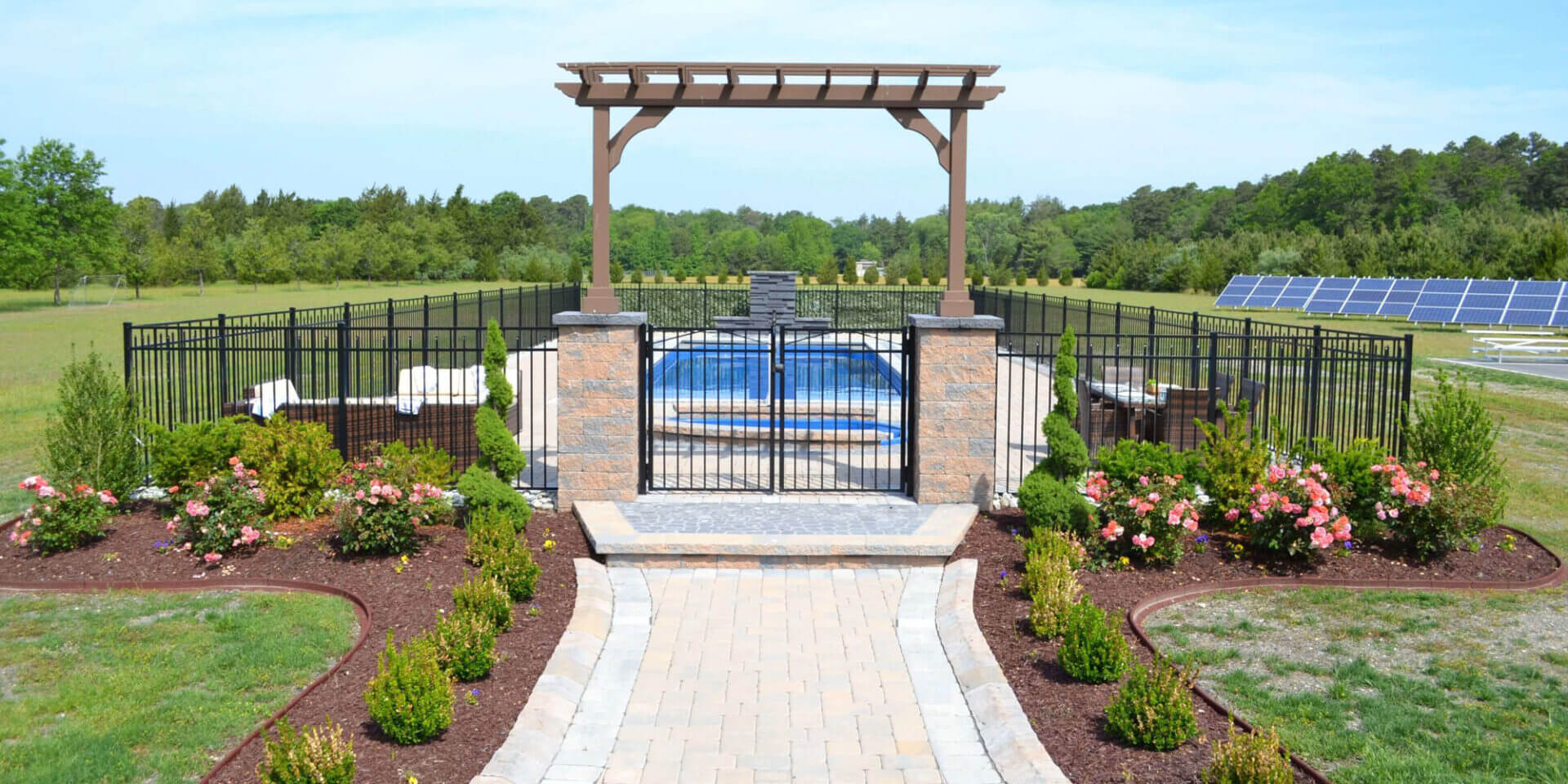
A pergola or pavilion over the cooking area more than doubles usable days for most homeowners. It has to be planned before the base goes in, because the posts need their own footings and retrofitting them into a finished kitchen means opening it up.
Ventilation is non negotiable under a solid roof. A grill under an enclosed pavilion without a hood is a carbon monoxide risk, not just a smoke nuisance.
Four questions.
Have you built one that has been through five winters? Ask to see it. Freeze damage shows up in year three, not year one.
Who pulls the gas permit? If the contractor says no permit is needed for a natural gas line, walk away.
What is the appliance spec? Openings must be built to the manufacturer’s exact cutout dimensions. A quarter inch off and your grill does not drop in.
What is under the island? Back to the foundation. It is the question that reveals whether they think of this as a structure or as decoration.
Then look at the work. Our completed outdoor kitchens show the finish level and the stone integration, which is what you are actually buying.
An outdoor kitchen contractor who only builds kitchens will hand off the patio, the lighting, and the pergola to other trades, and you will coordinate three schedules.
Building the kitchen as part of the whole outdoor living plan means the outdoor lighting conduit is already run, the pergola footings are already poured, and the patio grade already accounts for drainage away from the island. One crew, one sequence, no finger pointing.
The kitchens that get used every week are the ones designed around how the homeowner actually cooks, on a foundation built for the load, with a roof over the grill.
Request a consultation and we will look at your space, your grade, and your utilities, and tell you honestly what it will take.
A basic built-in grill island typically starts around $12,000 to $18,000. A full kitchen with counters, refrigeration, a sink, storage, and a covered structure commonly runs $35,000 to $75,000 or more. Gas line runs, electrical work, and foundation requirements drive a large share of the variation.
Almost always, yes. Natural gas lines and electrical circuits require permits in essentially every township, and adding a roof structure typically triggers a building permit as well. A contractor who tells you no permits are needed for gas work is a serious red flag.
Standard indoor quartz is not suitable for outdoor use in New Jersey. UV exposure degrades the resin binder and can cause discoloration or failure, and freeze thaw cycles compound it. Granite, dense porcelain, or specifically outdoor rated quartz are the safe choices.
Fall and early spring are ideal. The ground is workable for footings, crews have more availability than in the summer rush, and building in fall means the kitchen is ready for the first warm weekend. Masonry work needs temperatures above freezing to cure properly.
If budget allows, yes. A pergola or pavilion over the cooking area extends usable months significantly and protects appliances and counters from weather. It must be designed in from the start because the posts require their own footings, which cannot easily be added after the kitchen is built.